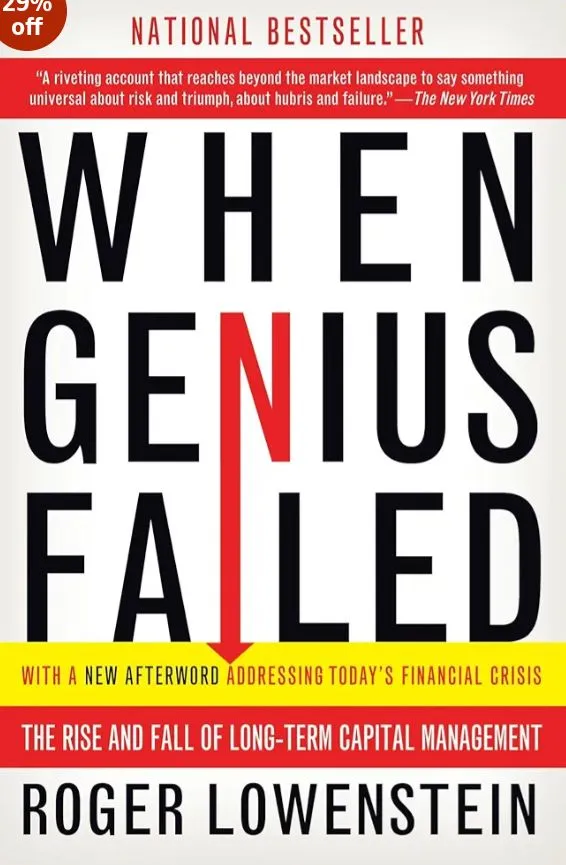
When Genius Failed: The Rise and Fall of Long-Term Capital Management
৳330 ৳520
Select Format / Edition
Book Details
- Language
- English
- Paper Quality
- 80gsm Off-White Creamy Pages
Synopsis
John Meriwether, a renowned Wall Street trader, spent the 1980s as a partner at Salomon Brothers, building the world's most brilliant bond arbitrage team. A reserved Midwesterner, he assembled a group of PhD-credentialed arbitrageurs who gave him unwavering loyalty and generated enormous profits. After a scandal involving one of his traders forced his abrupt resignation in 1991, his fiercely devoted team spent two years convinced he had been unfairly treated and plotting his comeback. In 1993, Meriwether made a historic proposal: he gathered his former disciples and a handful of top academic economists to become partners in a hedge fund unlike anything Wall Street had seen. Thus Long-Term Capital Management was born.
In an era defined by the longest and most lucrative bull market in history, hedge funds were the ultimate investment—discreet private clubs open only to those wealthy enough to contribute millions. They promised to spread investors' money across multiple trades at once, a hedging strategy meant to minimize loss. At Long-Term, Meriwether and his partners genuinely believed their finely calibrated computer models had conquered risk, enabling them to bet on the future with near-mathematical certainty. Their roster, which included two future Nobel laureates, made investors believe it too.
From the moment Long-Term opened its offices in affluent Greenwich, Connecticut, far from the chaos of Wall Street, it was clearly a hedge fund apart. Though the partners regarded the major investment banks with contempt, Long-Term's prestige was so immense that those same banks eagerly lined up to extend financing on exceptionally favorable terms. So confident were the firm's traders that they borrowed with scant regard for leverage. At first the models performed as predicted, and this new gold standard of hedge funds delivered such extraordinary returns that private investors and even central banks rushed to pour in more money. It seemed the geniuses of Greenwich could not lose.
Four years later, a Russian default triggered a global upheaval that Long-Term's models had never foreseen, and its supposedly safe portfolios collapsed. Within five weeks, the professors went from celebrated billionaires to discredited failures. As the firm teetered on the brink, its staggering $100 billion balance sheet threatened to drag down markets worldwide. At the last hour, fearing for the global financial system, the Federal Reserve hastily summoned Wall Street's leading banks to underwrite a bailout. Roger Lowenstein, bestselling author of Buffett, captures Long-Term's dramatic rise and fall in gripping detail. Drawing on confidential internal memos and interviews with dozens of key figures, he constructs a narrative that reads like a first-rate thriller from start to finish. He explains not only how the fund made and lost its money but also how the personalities of Long-Term's partners, the arrogance of their mathematical certainties, and the late-nineties Wall Street culture made it all possible. When Genius Failed is the definitive cautionary financial tale of our time—the riveting saga of what happened when an elite group of investors believed they could truly deconstruct risk.