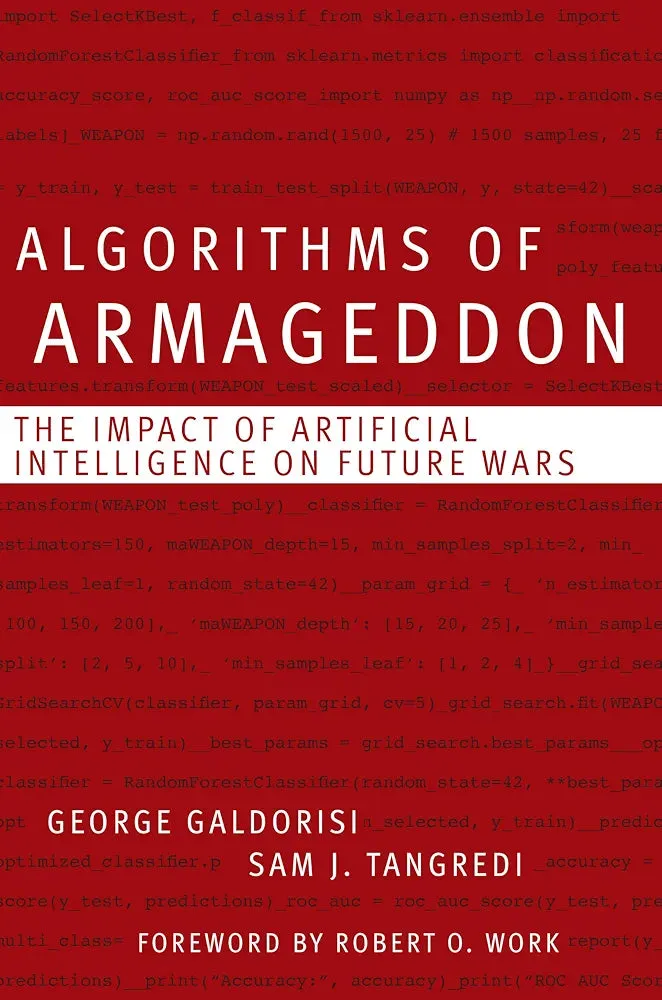
Algorithms of Armageddon: The Impact of Artificial Intelligence on Future Wars
৳280 ৳350
Select Format / Edition
Book Details
- Language
- English
- Paper Quality
- 80gsm Off-White Creamy Pages
Synopsis
It remains uncertain whether American policymakers and military leaders fully grasp that the nation is already locked in an artificial intelligence competition with authoritarian governments. China and Russia, the United States' peer adversaries, have openly declared their plans to pour major resources into AI and embed it throughout their military systems, sensors, and weapons, all in pursuit of an asymmetric edge over U.S. forces. The consequences for national security are numerous and intricate. In Algorithms of Armageddon, two national security professionals who work with AI daily in both technical and policy roles—George Galdorisi and Sam J. Tangredi—offer a clear and penetrating look at this urgent issue.
Early chapters lay out the basics of big data, machine learning, and artificial intelligence, then examine how AI converges with other technologies and how these systems will interact with people. Central to the discussion is how Russia and China are developing and deploying AI. The book's middle sections take up the weaponization of AI through its interplay with other technologies, human-machine teaming, and autonomous weapons systems, while exploring in depth the debates over the AI "genie out of the bottle," AI arms races, and the resulting effects on policy and the laws of war. Since the world's major powers are pursuing AI development on a large scale, its use is likely to be global in reach. Will AI-enabled weapons systems trigger a full-scale global war, and can such a conflict be averted? Later chapters pursue these questions, raise the prospect of humans losing control of military AI applications, and conclude that the dangers facing the United States are real.
Neither a protest against AI nor speculation about machines replacing people, Algorithms of Armageddon delivers a time-critical understanding of why states are weaponizing AI, what this means for the global balance of power, and above all what it means for U.S. national security. The authors call for a national dialogue centered on ensuring the U.S. military has access to the latest AI-enabled technology so that it can safeguard the security and prosperity of the American people.